A wedding in India is inseparable from gold. It appears in the ceremony, in the gifts exchanged between families, and in the jewellery the bride wears from the mehendi through to the reception. For many families, the jewellery purchased for a wedding represents a significant financial commitment and an even more significant emotional one. Getting those choices right means thinking beyond trends and asking what will still feel meaningful and wearable twenty years from now.
That question, what makes jewellery timeless, is not as difficult to answer as it might seem. Certain forms, proportions, and design languages have recurred across Indian jewellery for centuries because they work. Understanding what they are, and why, is the starting point for building a bridal jewellery set that holds its value in every sense.
Start with the Necklace: The Centrepiece of Bridal Jewellery
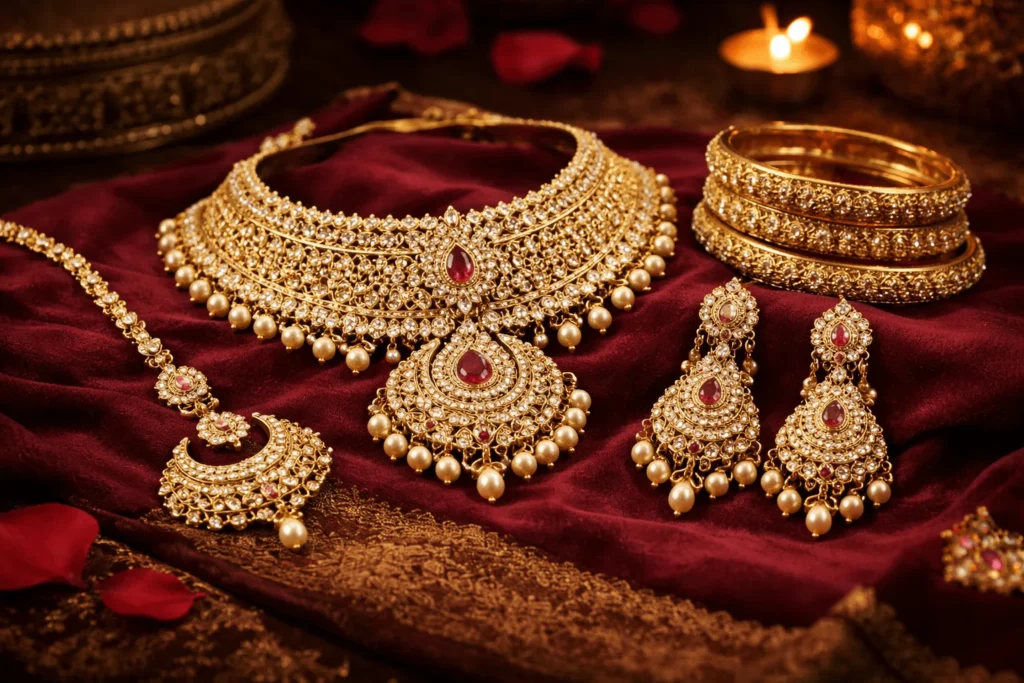
In most Indian bridal contexts, the necklace or haar is the dominant piece. It sets the visual tone for everything else. Bridal necklaces fall broadly into two categories: the elaborate, heavily set pieces designed for wedding-day impact, and the more refined, polished pieces that work for receptions, anniversary dinners, and festive occasions for years afterwards.
Traditional forms like the rani haar, choker, and layered necklace sets carry deep cultural roots. The polki and kundan traditions from Rajasthan and Gujarat, the temple jewellery of Tamil Nadu, and the kolhapuri saaj of Maharashtra each represent a regional design language with its own distinct vocabulary. Brides from these communities often choose pieces that reflect their heritage, while others mix influences to create something that feels personally meaningful.
When choosing gold necklace sets for a wedding, the most reliable approach is to prioritise craftsmanship and gold quality over novelty. A well-made 22-karat necklace in a classic form will outlast a trendy design by decades. It will also be easier to repurpose, resize, or pass down within the family.
Understanding Gold Purity for Bridal Pieces
Gold purity matters more for bridal jewellery than for fashion pieces because the investment is larger and the expectation is longevity. In India, 22-karat gold is the standard for traditional jewellery. It has a high enough gold content to hold intrinsic value while being workable enough for detailed craftsmanship. 18-karat gold is typically used for diamond-set pieces because it provides a harder setting for stones.
BIS hallmarking, now mandatory across India, confirms that the purity of the gold matches what the jeweller has stated. Always insist on a hallmark certificate and keep it safely with your other important documents. For insurance and future resale, the hallmark is an essential proof of quality.
Making Charges: What They Mean and How to Evaluate Them
Beyond the gold rate, every piece of jewellery carries a making charge that reflects the complexity and time involved in crafting it. Handcrafted pieces with intricate filigree, meenakari enamel, or stone-setting typically carry higher making charges than machine-made designs. For bridal jewellery, the making charge is often worth paying because the craftsmanship is part of what makes the piece distinctive and durable.
Bangles and Kadas: Often Overlooked, Always Essential
While the necklace commands the most attention, bangles and kadas are worn most frequently and therefore matter enormously to a bride’s daily jewellery life. The traditional red and white bangles of a Maharashtrian bride give way over time to gold bangles and kadas that can be worn to work, at social occasions, and on festive days throughout the year.
A well-chosen gold kada, in particular, is one of the best long-term investments in a bridal jewellery set. Unlike a bangle that requires precise sizing, many kadas have an open back that allows for adjustment. Gifting gold kadas for the bride’s family is also a popular choice for families who want to give something the recipient will wear regularly rather than keeping it locked away.
Earrings: The Piece You Will Wear Most
After the mangalsutra, earrings are the piece most brides wear most consistently after the wedding. This makes the earring choice particularly important. For the wedding day, jhumkas, chandbalis, and long chandelier earrings create visual drama. For everyday use, a pair of diamond studs or small gold drops will get far more use and deserve equal attention.
Many brides make the mistake of investing heavily in elaborate earrings for the ceremony and neglecting to buy a simple, high-quality daily-wear pair. Building a complete bridal set means thinking across both registers, occasion jewellery and daily wear, so that the investment serves you across all the moments that follow the wedding.
Coordinating Across Pieces
One of the more practical challenges in building a bridal jewellery set is ensuring that the individual pieces work together without looking mismatched. The simplest rule is to stay consistent with metal tone: yellow gold pieces work together naturally; mixing yellow gold with white gold or platinum requires deliberate styling.
Within yellow gold, mixing 22-karat traditional pieces with 18-karat diamond-set pieces is common and visually cohesive. The different karats read as the same metal in natural light, so the distinction does not create a visual conflict.
A Final Word on Longevity
The most timeless bridal jewellery is not the most elaborate or the most expensive. It is the most honest to its own design language and the most thoughtfully chosen for the person who will wear it. Take the time to try pieces on with the outfits you are considering, in different lights, and at different times of day. The piece you keep returning to, the one that feels right rather than just impressive, is usually the right choice.
For families planning a wedding in Mumbai or visiting from other cities, the showrooms at Waman Hari Pethe Sons offer over a century of expertise in bridal jewellery and a range that spans traditional Maharashtrian forms to contemporary diamond-set designs. The team is well placed to help you build a set that will remain meaningful far beyond the wedding day.